Some of you may have noticed a recent news article about a peace deal between Rwanda and DR Congo. I want to provide a little history and then explain why I am talking about this in a blog post that is an ongoing report of our mission here in South Africa. I hope you will take the time to read this…
On December 4, 2025, Presidents Félix Tshisekedi (DRC) and Paul Kagame (Rwanda) formally ratified a U.S.-facilitated peace package in Washington D.C. The ceremony was attended by and championed by President Trump.
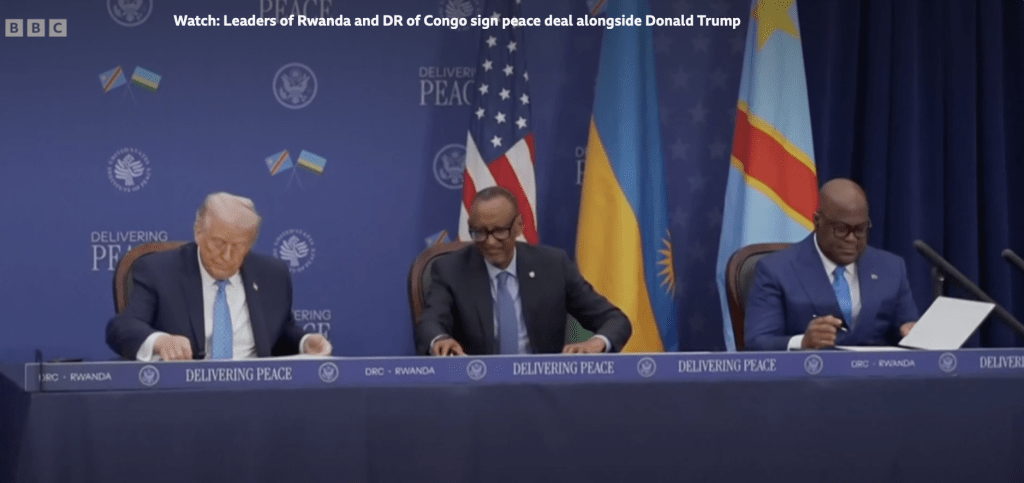
Before I lay out the key elements to the deal, this whole mess requires some context. There are three main ethnic groups in Rwanda. The Hutus, the Tutsis and the Twa. The genocide in 1994 revolved only around the Hutus and Tutsis. Interestingly enough, these two groups share the same language, culture, and religion, but historically have had different social roles. Hutus were mostly farmers, while Tutsis were often cattle herders and held more political power. Over time, these social distinctions were hardened into ethnic identities, which contributed to deep tensions and conflict. This is what was behind the 1994 genocide in Rwanda.
The genocide that developed in 1994 was due to these long-standing and ever growing ethnic tensions between the Hutu and the Tutsi. To understand the origin of these tensions, we have to go all the back to 1897 when Rwanda became a German colony. After Germany’s defeat in WWI in 1916, Belgium took over and ruled the country until 1962, at which time Rwanda gained its independence. As already mentioned, the Hutus were mostly farmers and the Tutsis were known as cattle herders. Apparently, the colonial laws and policies enacted by both Germany and Belgium, favored the Tutsis over the Hutus. This “favoritism” began to canker and rot the relationships between the two groups and the division grew from a crack to a canyon as ethnic identities hardened. On April 6, 1994, the Hutu president Juvénal Habyarimana was assassinated when the plane carrying him and the Burundi president, Cyprien Ntaryamira was shot down as it approached Kigali airport in Rwanda. This immediately triggered the start of a genocide of Tutsis by Hutu extremists. The genocide ended with the advance of a force of Tutsi-led rebels commanded by Paul Kagame, who interestingly enough is now the president of Rwanda.
Once the Tutsi led rebels overpowered the Hutu rebels, an estimated 1,000,000 Hutus fled across the border into DR Congo, which then marginalized the Tutsi population in the area where the Hutus took refuge. Twice the Rwandan army invaded eastern DR Congo to capture and punish those who they claim were responsible for the genocide.
The next phase in this ongoing struggle was the formation of two opposing groups. The Hutu rebels became the FLDR (Democratic Forces for the Liberation of Rwanda) – a Hutu group in Eastern DRC which included some who 30 years earlier had a hand in the genocide. There continues to be claims that the DRC supports these Hutu rebels. The other group is a rebel Tutsi group called M23, named for a peace deal signed on March 23, 2009 by a previous rebel Tutsi group (did not hold). M23 is supposedly protecting the rights of the Tutsi’s who oppose everything the FLDR stand for. And guess what? There are believable claims that Rwanda is supporting this rebel group. So we have opposing rebel groups seemingly supported by their respective countries: 1) DRC and the FLDR. 2) Rwanda and the M23. In regards to the relative strength of these two groups, ChatGPT reports that “M23 is a modern, organized rebel force capable of conventional fighting, while FDLR is a degraded insurgent group that relies more on survival tactics than military dominance.” And interestingly enough, M23 has fewer numbers than FLDR.
Now, one more variable…eastern DRC is rich with minerals representing a vast amount of wealth which both the FLDR and the M23 want to control for their respective countries. There are serious claims by both the UN as well as the DR Congo, that Rwanda is funding the M23 in order to access these minerals. In fact the M23 has seized several of these mining areas recently and are reportedly sending these minerals to Rwanda. The primary minerals in question are gold and coltan. Coltan is a dull black metallic ore from which tantalum and niobium are extracted – elements critical for electronics used in capacitors for phones, laptops, and planes.
Below is a map of the area of conflict. In the small map, the country in white is the DR Congo.

One last important information element. The Peace Accord was signed on December 4th as already mentioned. However, despite the signing of that treaty, six days later on December 10th, the M23 marched into Uvira and took control of the city. Uvira lies 17 miles from Bujumbura, the capital city of Burundi and is important for one significant reason. There were at least 10,000 Burundian troops in South Kivu Province and it was through Uvira that these troops and supplies traveled. Cutting off that supply route is a big deal. Uvira had a population of about 700,000, and was the DR Congo government’s last major foothold and military hub in South Kivu province… and now it is controlled by M23 and Rwanda. (Burundi is supporting DR Congo and is against Rwanda and the M23).
Okay, that was a lot of context, but important to understand as I explain why I am even writing about this. Before I explain my reason for writing, let me cover the four key elements of the peace deal with links to the source of the reporting from which I drew this information:
- A commitment to a permanent ceasefire between the two states and to stop cross-border support for proxy armed groups. (Al Jazeera)
- Disarmament / neutralisation pledges: Rwanda agreed to end support for M23 (the rebel group active in eastern DRC) while the DRC agreed to act against Hutu militias (notably the FDLR). Implementation mechanisms were described but remain to be completed. (Al Jazeera)
- A regional economic-integration / minerals component that includes cooperation on critical minerals and arrangements intended to attract Western (especially U.S.) investment in the DRC’s resource sector. Critics note this economic element is prominent in the deal. (EFE Noticias)
- Creation/activation of joint security coordination measures and follow-up bodies to monitor withdrawal, disarmament and implementation (with regional and international partners involved). (ACP)
Within a week, the peace deal began to fall apart. Whether it can even be rescued at this point is a valid question. Much reporting is focused on the fact that M23 was not at that peace table so did not have any commitment to what was agreed. Some even say that Rwanda’s president was pushed into the deal, but his heart was never in it. Now add the USA component of potentially getting access to these minerals and the whole peace accord may have caused the fire to burn hotter rather than reduce it to glowing embers.
Now for why this is important. The three main cities that have been taken by the M23 are Goma, Bukavu, and most recently Uvira. Why are these towns significant? Because we have a branch of the Church in all three. And interestingly enough, they are part of the Rwanda Kigali Mission due to proximity and history of the people. The Rwanda Mission also includes Burundi. These three branches have been producing a significant number of young missionaries. Getting them out of the DRC and through Rwanda and into Burundi so they can eventually get to the DRC Embassy in Bujumbura is not easy. Airlines will not allow these young missionaries to board planes with M23 documents. This means they have to get to a DR Congo Embassy in Burundi to get papers that allow them to fly to the MTC in Kinshasa which is on the western border of DR Congo. We currently have one missionary from Uvira due to come to the MTC this week, but with M23 now in control of Uvira, that has been put on hold. We have two brothers, also from Uvira, who have calls to serve starting in March and April, and those we will watch to see what happens. Fortunately they have an elder sister who lives further south in a town called Kalemie who has brought her brothers there for now to keep them safe.
It is one thing to read about these things happening in a distant land. It is an entirely different thing to be close to the impact this is having on the Church and these young elders and sisters. Please pray for these missionaries that this whole situation can be resolved peacefully. There is so much wealth in these minerals that a change in the mentality from scarcity to abundance could have a big impact. Moving from win-lose thinking to win-win thinking would also make a big difference.
If you have made it this far in the post, I am impressed. This post is heavy with ethnic history, geography, current events, and social and spiritual impacts. Satan is having his way right now and we need the power of heaven to supersede. May it be so! Before posting this, I did a quick check to see the latest information on the conflict. Here is a link to a good article by the BBC where the rebels promise to leave Uvira at the request of the US. No withdrawal yet, but a good indicator there may be hope to salvage the deal.
Serving in South Africa is perhaps the most interesting assignment we have had. LaDawn continues to process significant numbers of new missionary applications, many of them incomplete and needing additional information. But good applications of good young men and young women with a great desire to serve their God. There is no doubt that the hand of the Lord is moving across the land. Dreams and visions of truth are common for a people who have waited centuries for the light of the fullness of the Gospel of Jesus Christ to become available. The growth is staggering in Africa. Satan is never happy about losing lands and people over whom he has had significant influence for hundreds of years. But it is happening right before our eyes. And the good news? We know who wins.
Discover more from Kunz Corner
Subscribe to get the latest posts sent to your email.
 Kunz Corner
Wow! That is quite the history on intrigue and evil. May light continue to conquer!
Sent from Gmail Mobile
LikeLike
Wow that’s a complicated situati
LikeLike
How tough for those future missionaries to be pulled into all of this! Prayers for a quick and safe resolution!
LikeLike
We pray for Africa at home, at church, in the Temple and keep you in mind and heart always. We will focus specifically on the Rwanda mission now. We love you both, W/R
LikeLiked by 1 person